

For engineers
How owned AI works.
The model, the loop, the gate and where it runs. What runs today says so. Everything else is planned or a target.
Four parts
Experts, a gate, a record and the machines they run on.
 ExpertsSmall LoRA adapters on one frozen open base, one per team.
 The gateGolden set, held-out weeks, a paired test and a shadow run. Then promote or roll back.
 The recordEvery release, its test result and who approved it. Rollback is designed for 60 seconds.
 The machinesInstalled from templates, on your machines or ours. The templates are part of the first milestone.
Measured on every update: task accuracy, p95 latency, cost per request and refusal rate. Pilot defaults: 200 or more sealed items per team, three trials each.
The release gateThe system
Most requests never need the big model.
A small decision model reads each request, answers with a confidence, and sends only the hard ones to the main expert.
- RequestTyped, from an app, a connector or your API.
- Decision modelAn answer and a confidence.
- ConfidentFast path: it acts at once.
- UnsureThe main expert, your larger model. Or “no call”.
- LoggedKept for review and approval.
80 to 90%
of requests without the main expert. A target, to be measured in pilots.
Measured on an open 0.42B model. Routing stays fixed until it is calibrated per client.
Experts
One open base, many small experts.
The base is frozen and loaded once. Each team gets small LoRA adapters trained on its approved work, swapped per request on one server.
- LoRA
- Up to 10,000 times fewer trainable parameters (Hu et al., 2021).
- QLoRA
- A 65B model fine-tuned on one 48 GB GPU (Dettmers et al., 2023).
- LegalAdapter
- SupportThis request
- RiskAdapter
- OperationsAdapter
- CodeAdapter
How an expert is made
A big model teaches a small one.
- A large open model answers your task prompts.
- Graders keep only the answers that pass.
- Your small expert learns from them, and from your own examples.
Only teachers whose licence allows distillation. Every teacher answer is traced to its source.
Then it practises.
- The expert answers one real task several times.
- Your grader scores every try.
- Tries above the group average are reinforced; the rest are not.
GRPO needs no separate critic model, so training needs less compute (Shao et al., 2024).
Two loops
It gets better at two levels.
Harness search alone: +7.7 points with 4 times fewer context tokens. Meta-Harness, arXiv 2603.28052, 2026.
Installed from templates
Four layers, one reference stack.
- Serving
- vLLM, multi-LoRA
- Training and open weights
- PyTorch, Hugging Face
- Cloud installs
- Kubernetes, with Helm and Terraform
- Machines
- Apple silicon, NVIDIA RTX and GB10, about 32 GB of memory or more
Under two weeks
for a new install from the templates. A target; the templates are part of the first milestone.
Nine model families
One loop for every kind of model.
| Family | Bases, for example | Result |
|---|---|---|
| TLM, time series | Kronos-small (MIT licence, verified) | Has a result |
| LLM, language | gpt-oss-20b, Qwen3.5 9B, Mistral Small 3.2 | Not yet |
| Voice | Whisper large-v3, Parakeet TDT, Kokoro-82M | Not yet |
| Image | FLUX.2 klein 4B, Qwen-Image, Z-Image-Turbo | Not yet |
| Video | Wan 2.2, CogVideoX-2B | Not yet |
| Robotics | SmolVLA, pi0, GR00T N1.6 | Not yet |
| Routing | Laya 0.42B, Qwen2.5-3B with GRPO | Not yet |
| 3D | TripoSG with a LoRA adapter | Not yet |
| Guardrails | An open-weight classifier, to choose | Not yet |
Licences: Kronos-small (MIT) verified; every other base is checked before use. Proof Ladder: 54 cells, 1 done, 1 partial, 52 to run.
What runs today
Runs today, and what is next.
Runs today
- The first expert
- The scoring harness and sealed tests
- Training
- benchmarks.eigna.ai
- A prototype of the app flow
In development
- Eigna Console
- The Model Deed
Planned
- Learning in production
- Run modes as a product
- Eigna Companion
- Connectors
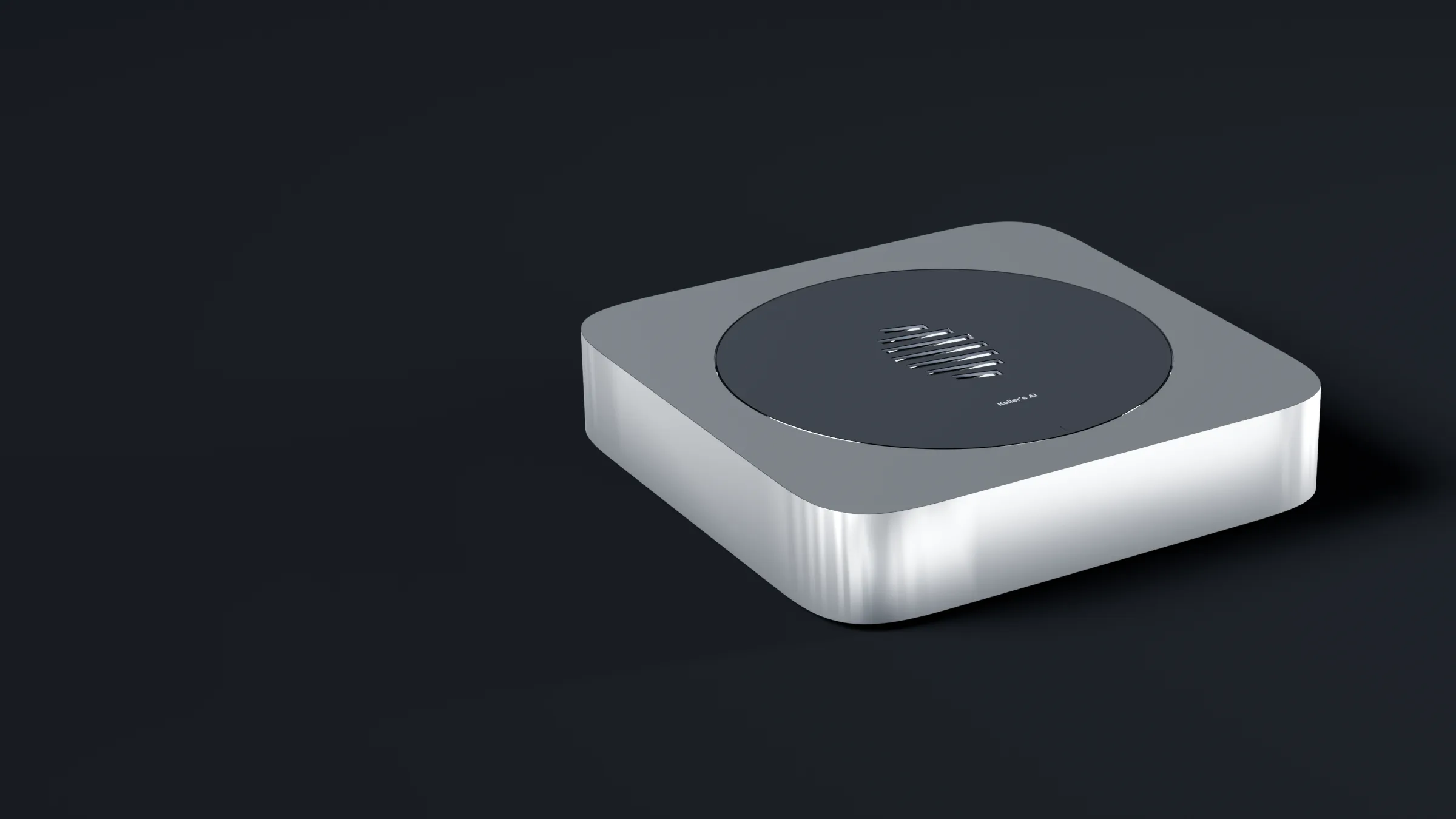
- The first Eigna Box
- Experts beyond forecasting
- A tuned decision model
- Audit log and refusal training
Target
- Decision model under 10 ms
- 80 to 90% of requests
- A new install in under two weeks
- Rollback in 60 seconds
Open problems
Problems we are solving next.
- Learning from little dataTraining can start at 50 approved examples. How far can a small expert go from there?
- A router that knows its limitsCalibrated per client, under 10 ms: it escalates only what it should.
- Evaluation that stays cheapTests, trials and shadow runs for every update, cheaper than the training they judge.
- Models that fit a boxA strong expert compressed into desk-sized memory, without losing quality.
First on the list: beat the simple baselines. Benchmark 001 does not yet.
Start
Bring a hard problem. Leave with a plan.
A technical session on one of your tasks. Or join us and build it.